
A Deer Caused My Crash. Who Is Responsible for My Injuries?
For drivers in North Georgia and Tennessee, seeing a deer along the side of the road can produce immediate reactions that could be helpful or harmful.
While no driver can eliminate all risks of hitting a deer, following some basic precautions can give you the best chance of avoiding a collision. It can also help minimize the severity of a crash caused by an instinctive attempt to swerve. 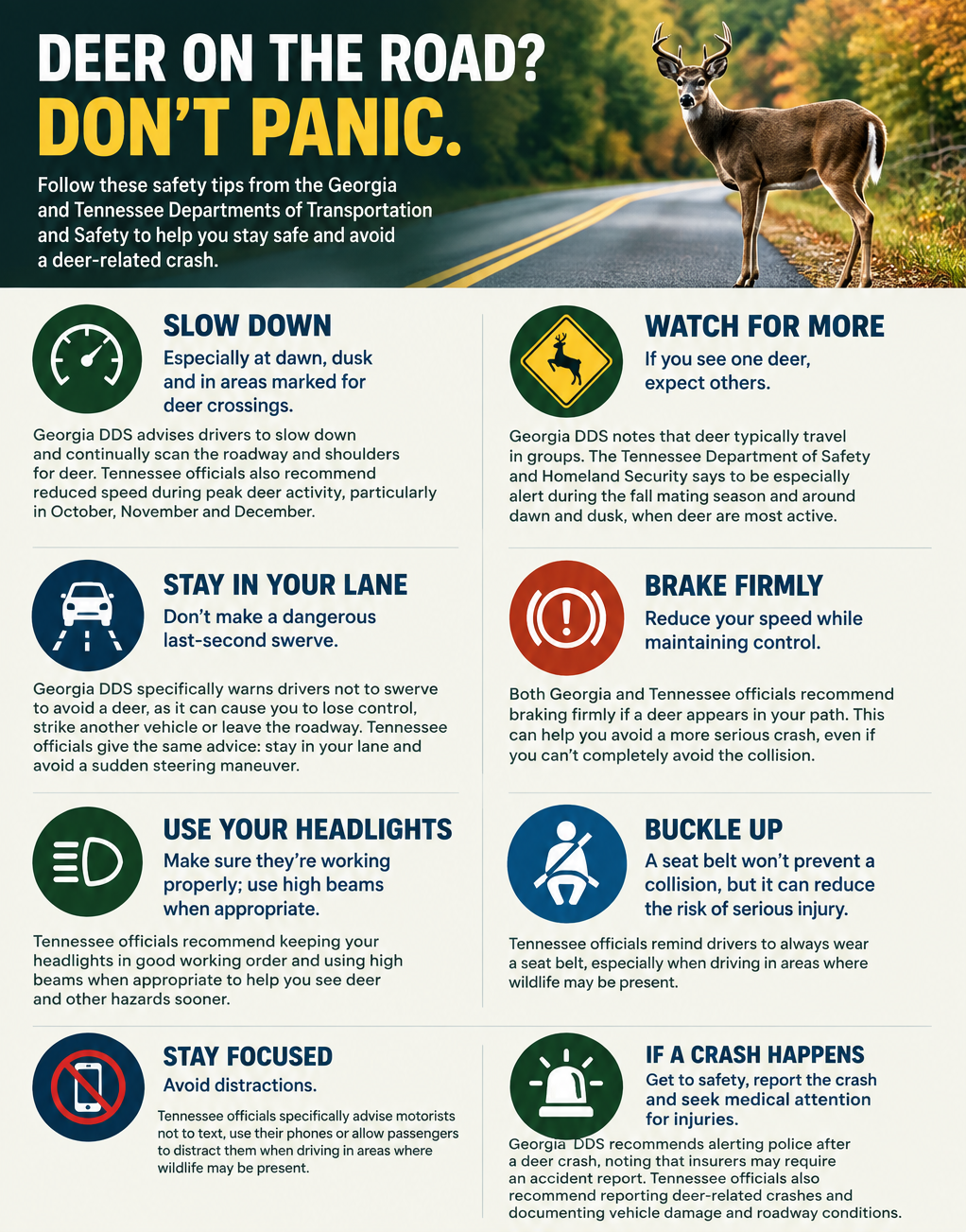
Motorcyclists and car and truck drivers should understand that if reasonable precautions are taken and a deer suddenly enters their path, a collision will not automatically mean drivers were negligent. This is critical to know whether you are a claimant or defendant.
Deer Crashes Increase in the Fall in North Georgia and Tennessee
Fall is mating season for deer in Georgia and Tennessee and both states’ officials say deer are most active during October, November and December, during peak breeding and migration season. Deer are also commonly seen along roadways during early morning and late evening hours.
According to the Tennessee Department of Safety and Homeland Security (TDSHS), in 2024:
- 8,036 deer-related crashes occurred in Tennessee.
- This includes 465 injury crashes and five fatal crashes.
- An estimated 7,571 collisions resulted in property damage.
November is the state’s historically busiest month for deer-related crashes. Most occur on rural roads, where higher speeds and limited lighting can make collisions tougher to avoid.
The key takeaway is that drivers don’t necessarily have to be doing anything wrong for a deer crash to happen. Sometimes an animal simply appears in the roadway with little warning.
Slow Down When Deer Are Nearby in North Georgia or TN
The best way to avoid a deer collision is to give yourself more time to react.
Both Georgia and Tennessee transportation and safety officials recommend reducing speed and paying particular attention in areas where deer are known to cross.
Georgia’s Department of Driver Services (DDS) advises drivers to continually scan the roadway and shoulders for deer, particularly around dawn and dusk when they are known to travel. If a deer crosses the road, or if you see one alongside the road, slow down because deer typically travel in groups.
Afterward, do not immediately resume normal speed after the animal crosses the road. Give yourself additional time and space to make sure another deer isn’t following.
Don’t Swerve to Avoid a Deer in North Georgia or TN
This may be the most important piece of advice for drivers: If a deer suddenly runs into your path, don’t swerve.
It may seem counterintuitive. A driver naturally wants to avoid hitting the animal at all costs. But a sudden steering maneuver can create a much more serious danger: It can cause the vehicle to strike another vehicle or leave the roadway, potentially resulting in more serious damage or injuries.
A driver who swerves may lose control, cross into oncoming traffic, hit another vehicle or leave the roadway and strike a fixed object.
We have seen the evidence and can confidently say that a damaged bumper is preferable to a head-on collision.
Of course, every situation is different. Drivers should respond to the actual traffic and roadway conditions around them. But as a general rule, the official guidance in both states is clear: don’t make a dangerous, last-second swerve simply to avoid an animal.
What If You Can’t Avoid the Deer in North Georgia or TN?
If a deer suddenly appears directly in front of your vehicle, Georgia DDS advises drivers to slow down as much as possible to minimize the impact. Tennessee officials similarly recommend firm braking while maintaining control of the vehicle and remaining in the lane.
The practical goal is to avoid turning a wildlife encounter into a catastrophic crash.
Drivers should also keep their seat belts fastened, maintain a safe speed and avoid distractions. Generally speaking, motorists should not text, use their phones or allow passengers to distract them when driving in areas where wildlife may be present.
Does a Deer Crash Automatically Make the Driver Negligent in GA or TN?
No. This is an important distinction for drivers who may later worry that they will be blamed for an accident.
Negligence generally involves failing to act as a reasonably careful person would under the circumstances. A driver who is paying attention, traveling at a reasonable speed, responding appropriately to a sudden hazard and following applicable safety guidance is not automatically negligent simply because a deer runs into the roadway.
Tennessee courts have considered this issue in motor vehicle cases involving deer.
In Jones v. Ray, a motorcycle passenger argued that a driver was negligent after encountering a deer. The Tennessee Court of Appeals ultimately found insufficient evidence that the driver could reasonably have avoided the collision.
In Owings v. Owings, a driver swerved to avoid a deer and crashed. The Tennessee Court of Appeals concluded that the evidence did not establish that the driver’s decision to swerve was negligent. The plaintiff and defendant were divorced years prior to this crash in 2018, demonstrating how lawsuits between relatives can arise.
These cases don’t mean that every driver involved in a deer-related crash is protected from a negligence claim. The facts of each collision matter. But they illustrate an important principle: a deer suddenly entering a roadway does not, by itself, establish that a driver acted negligently.
What Should You Do After a Deer Crash in North Georgia or TN?
If you do collide with a deer, prioritize safety.
If you can safely move the vehicle away from traffic, do so and turn on your hazard lights. Call law enforcement when appropriate, particularly if anyone is injured or the crash creates a roadway hazard.
Georgia and Tennessee officials recommend alerting police after a deer crash, noting that insurers may require an accident report when processing a claim. Do not approach an injured deer. Wildlife can be unpredictable and dangerous, even when it appears incapacitated. Call 911 and ask them to dispatch animal control.
Once safe to do so, document vehicle damage and the roadway conditions. If you are injured, seek appropriate medical attention and document your injuries and treatment. State governments are immune from most liability claims, but you may be able to file a claim with your insurance carrier for property damage as well as your personal injuries.
Zach Pritchard: Your Motor Vehicle Wreck Attorney in North Georgia and Chattanooga, TN
Car wrecks frequently involve delayed braking and high-impact collisions, which can result in traumatic brain injuries, spinal cord damage, and other life-altering conditions. Insurance companies often attempt to dispute liability or minimize the severity of these injuries.
Pritchard Injury Firm is dedicated to helping injured clients across North Georgia and Tennessee investigate crashes, secure digital and physical evidence, and pursue compensation for medical care, lost income, and long-term needs.
If you or a loved one were injured on the road in Chattanooga or Nashville TN, or Cartersville or Woodstock, GA, experienced attorneys at Pritchard Injury Firm can help. Contact us online for compassionate legal guidance that establishes liability and helps you get the compensation needed to recover and move forward.